
Reviews: what customers reward and punish
The Reviews page (Ratings & Reviews) turns the review base of your whole category into something you can act on: where each product sits on quality versus credibility, what buyers consistently praise, what they consistently complain about, and which competitor weaknesses are stable enough to position against.
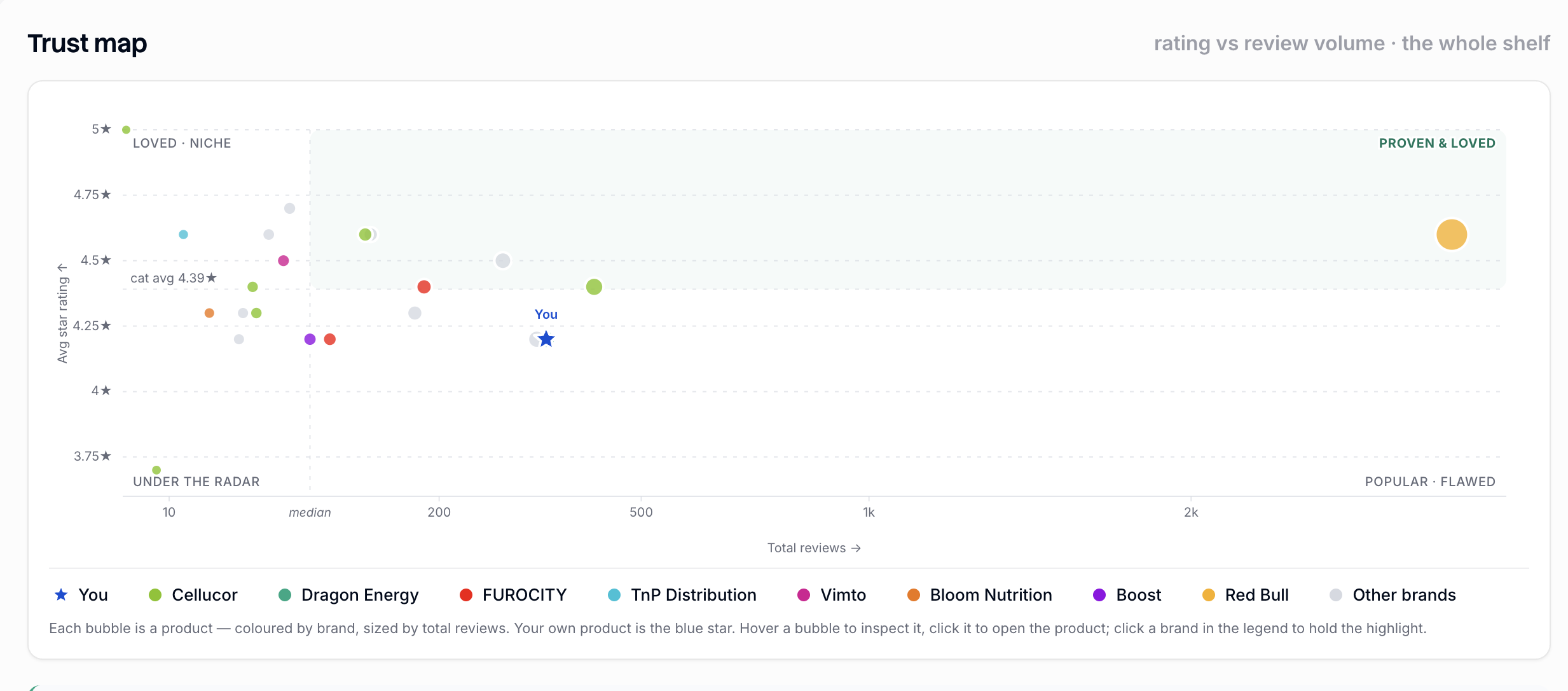
Trust map
A scatter of the whole shelf: average star rating up the side, total review volume across the bottom. Each bubble is a product, coloured by brand and sized by review count. Your own product is the blue star. The chart is split into four quadrants:
- Proven & loved — high rating, high volume. The credible benchmarks.
- Loved · niche — high rating, low volume. Promising but unproven.
- Popular · flawed — high volume, lower rating. Selling despite complaints, which usually means a real weakness you can name.
- Under the radar — low on both. Little signal either way.
Hover a bubble to inspect it, click to open the product, or click a brand in the legend to hold that brand's highlight while you compare.
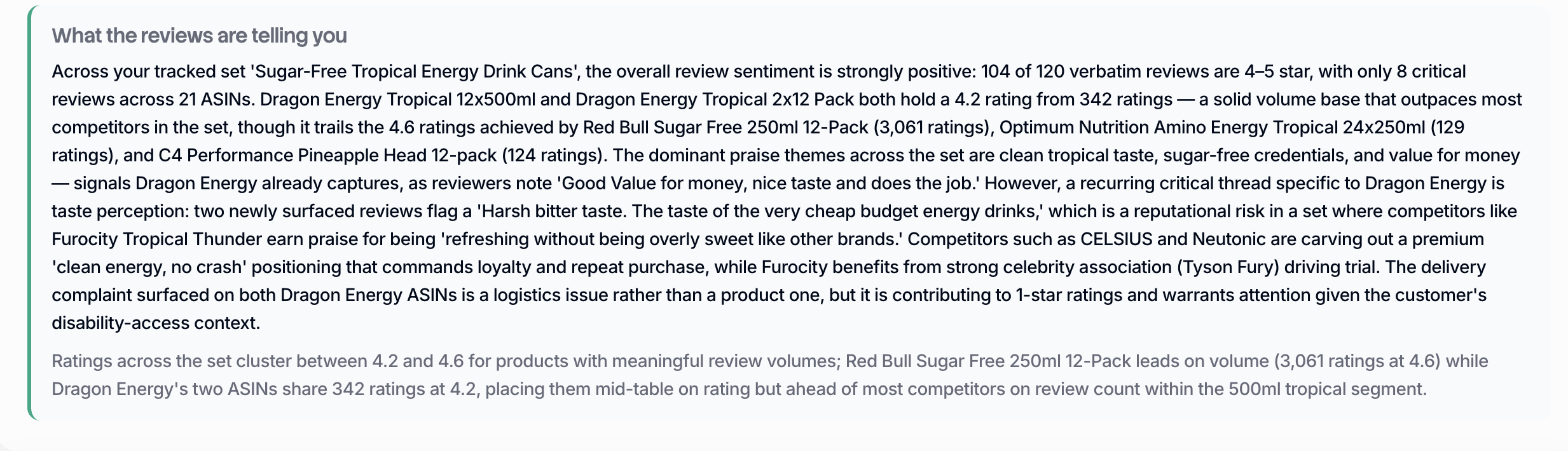
What the reviews are telling you
A written synthesis across the tracked review corpus: who holds the credible high ground, what the dominant customer complaint pattern is, which brands carry concentrated criticism, and — where relevant — where the clearest positioning opening sits for you.
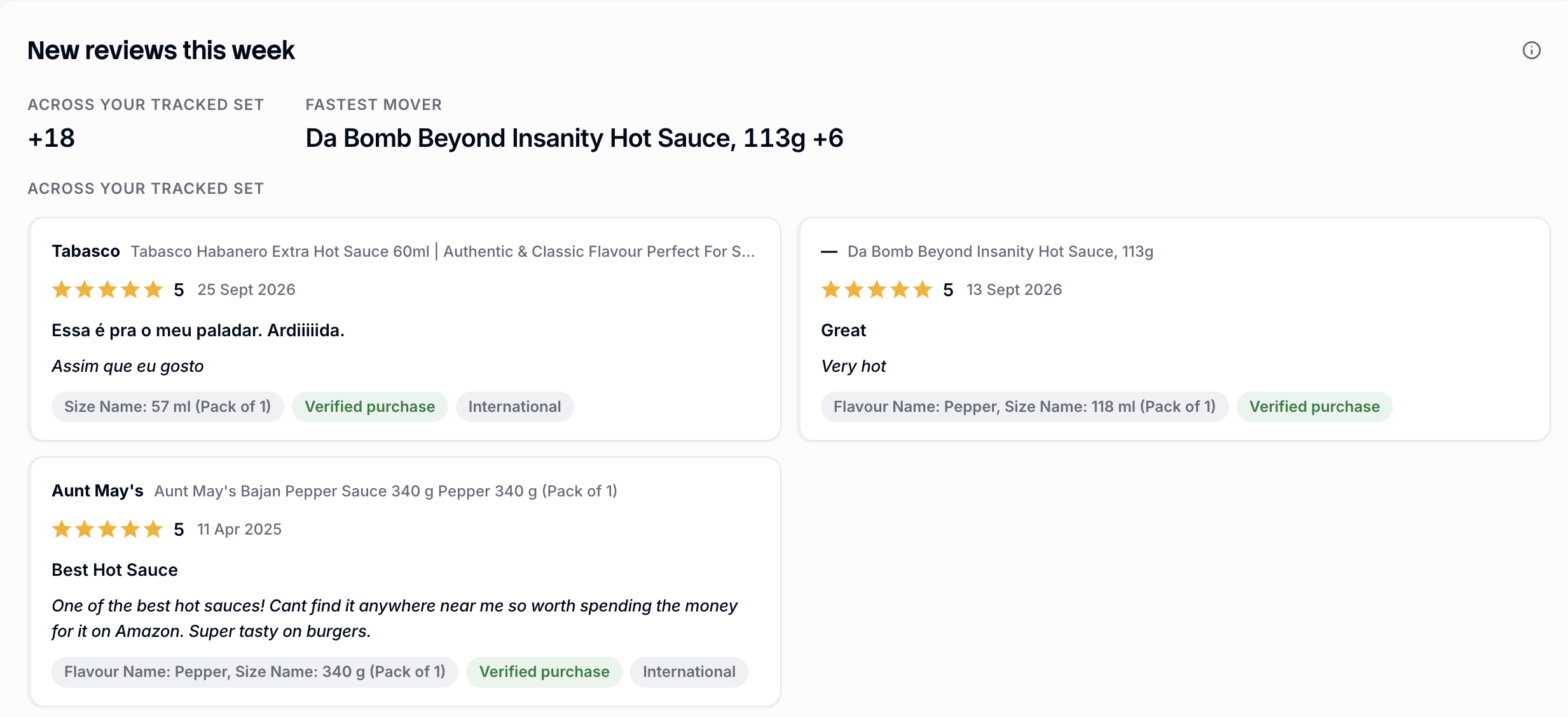
New reviews this week
Movement in the review base since the last capture:
- Across the shelf — net new reviews.
- Fastest mover — the product gaining reviews quickest, which is a reasonable proxy for velocity.
A note when the retailer has removed ratings, with the net movement. Review counts can go down as well as up; this is flagged rather than hidden.
Individual new reviews follow, each with the star rating, date, title, body, variant (where stated) and a verified-purchase marker. An important caveat is printed under this list: these are reviews newly surfaced on the retailer's review panel, and the date shown is when the review was written. Only some were written inside the current period.
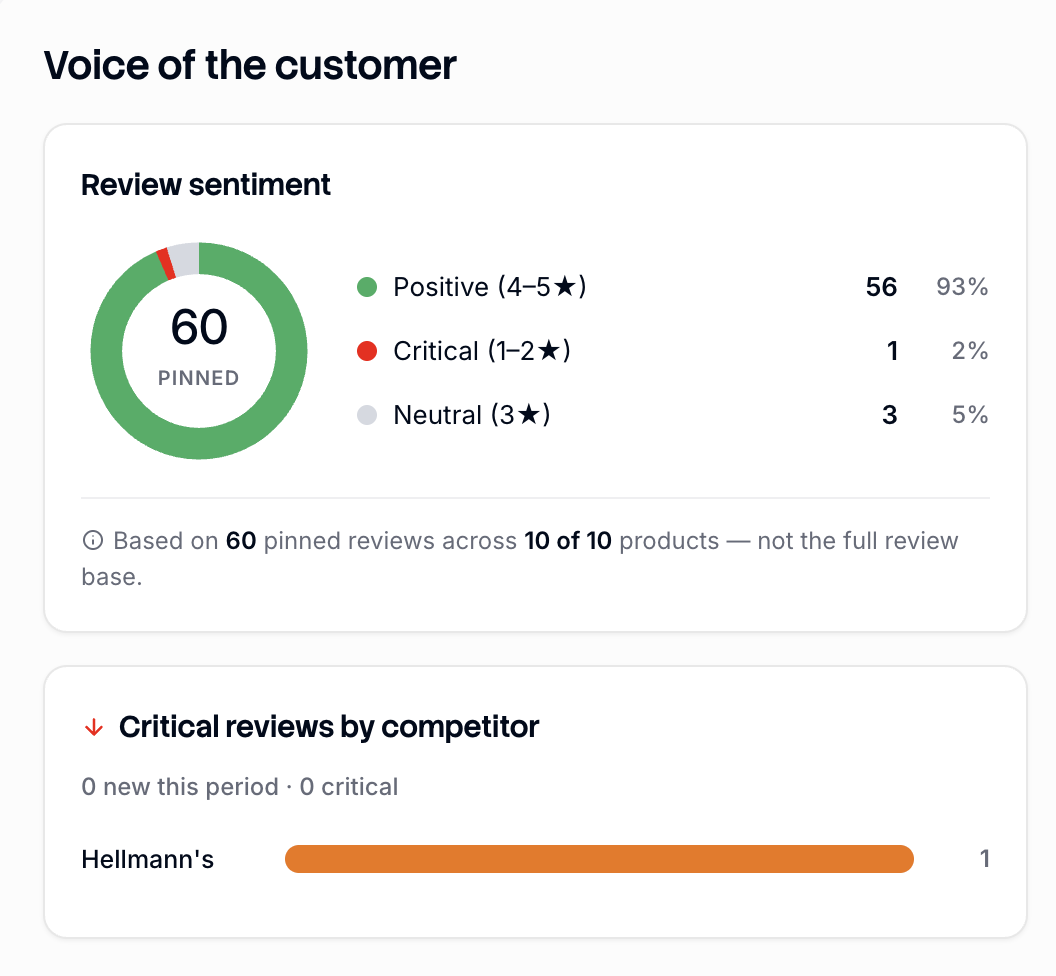
Voice of the customer
The analytical core of the page.
- Review sentiment — the split of pinned reviews into positive (4–5★), critical (1–2★) and neutral (3★), with the base clearly stated. This is a sample of pinned reviews across a subset of products, not the full review base, and the page says so.
- Critical reviews by competitor — which brands are attracting criticism, ranked. Concentration here is more meaningful than the absolute number.
- What shoppers reward — the recurring reasons buyers give for being happy, with verbatim quotes.
- What shoppers punish — the recurring failure modes, again with quotes and named brands.
- What shoppers are trying to do — the jobs customers describe hiring the product for. This is the closest thing on the page to a positioning brief.
- What the reviews keep saying — extracted themes with a count of how many reviews carry each. Tap a theme to read the underlying verbatim.
Competitor weaknesses you can position against
Named brands with a specific, repeated fault and a supporting quote. The bar for inclusion is a documented pattern rather than a single unhappy buyer, which is what makes these safe to build claims around.

Unmet needs in the category
Needs that appear across the review base with no product clearly serving them. These feed product development and range planning more than marketing — they are the "somebody should build this" list.

Notable reviews and Rating trend
A short pull of the most quotable new reviews, and a line chart comparing the top brand's average rating against the category average over the tracked periods.

Watch-outs
Low-volume ratings are not reliable - the page marks confidence explicitly, and a 5.0 from a handful of reviews should never be treated as a benchmark. Sentiment splits are based on a pinned sample, not every review ever written. And reviews describe experience after purchase; they are not a measure of demand.