Search: demand, brand share and rising needs
The Search page (Demand & Search) is the demand side of your tracker. Every other page describes supply — who is on the shelf, at what price, with what specification. This page asks whether anyone is actually looking for the category right now, which brands own that attention, and which needs are growing.
Why demand belongs next to the shelf
A rank is only meaningful relative to demand. Holding position on a shelf in a category that is falling is a very different situation from holding position while demand climbs, and the commercial response is different too: one calls for defending margin, the other for pressing an advantage.
Most consumer categories are also strongly seasonal, and it is easy to mistake a seasonal unwind for a competitive problem — or to commit launch spend into a structural headwind because the shelf still looks busy. This page exists to stop both mistakes.
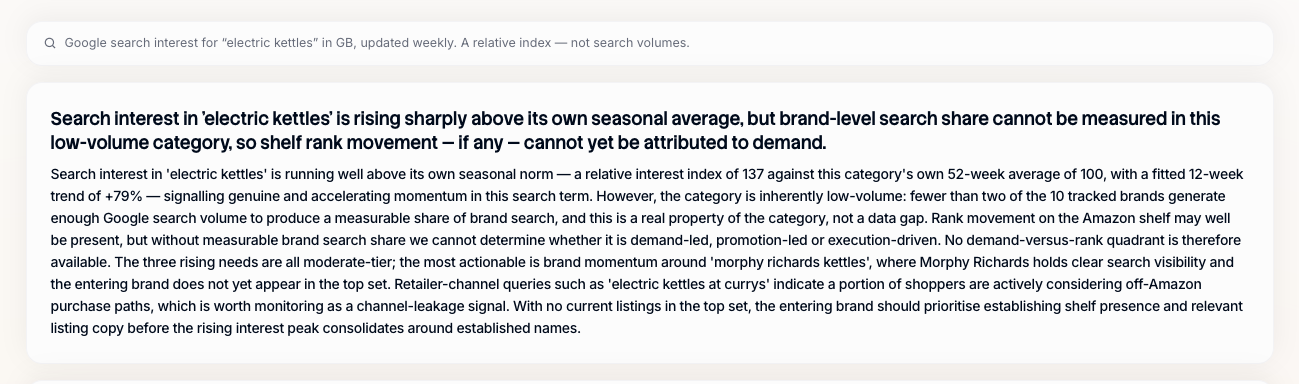
The data source is Google search interest for the category, updated weekly. It is a relative index, not search volumes. Everything here should be read as direction and proportion, never as absolute numbers.
Search interest over three years
The long view, on Google Trends' 0–100 index where 100 is the period of peak interest. Use it to establish the shape of your season, not to read this week. The current part-week is excluded so a half-captured week never looks like a collapse.
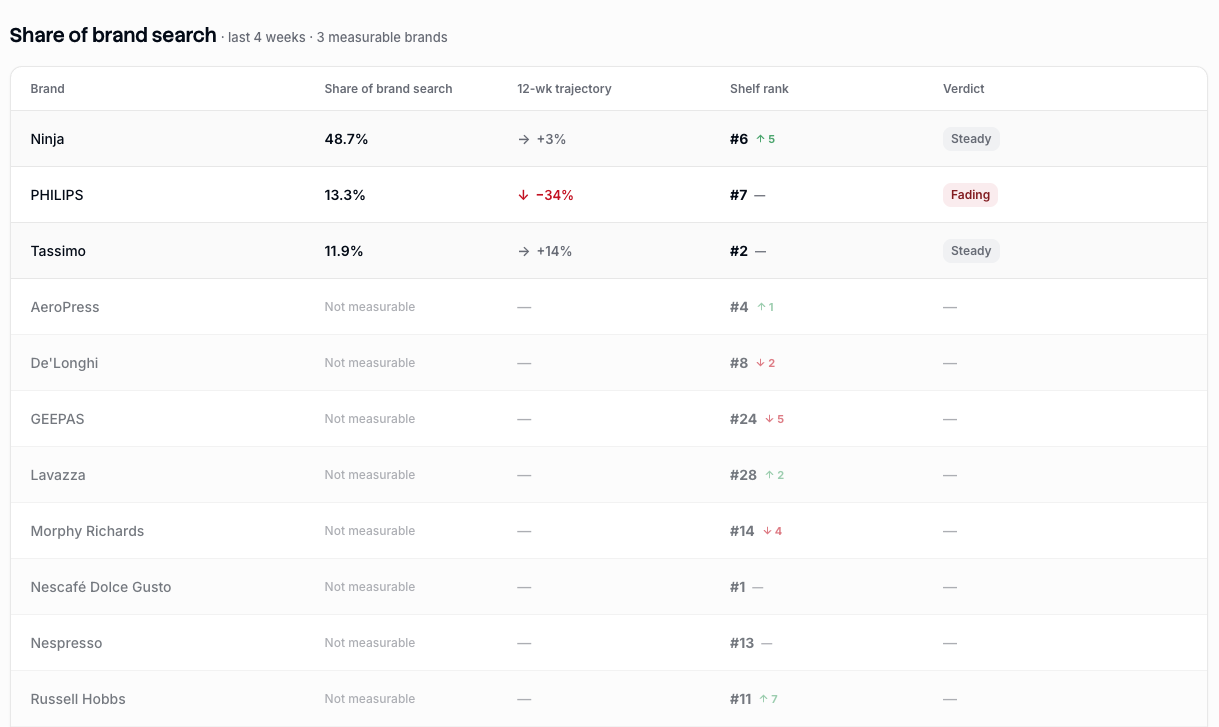
Search Demand
A table of the direction of search for your category, a search demand index, a 12 week trend and the relative search interest over the last three years.
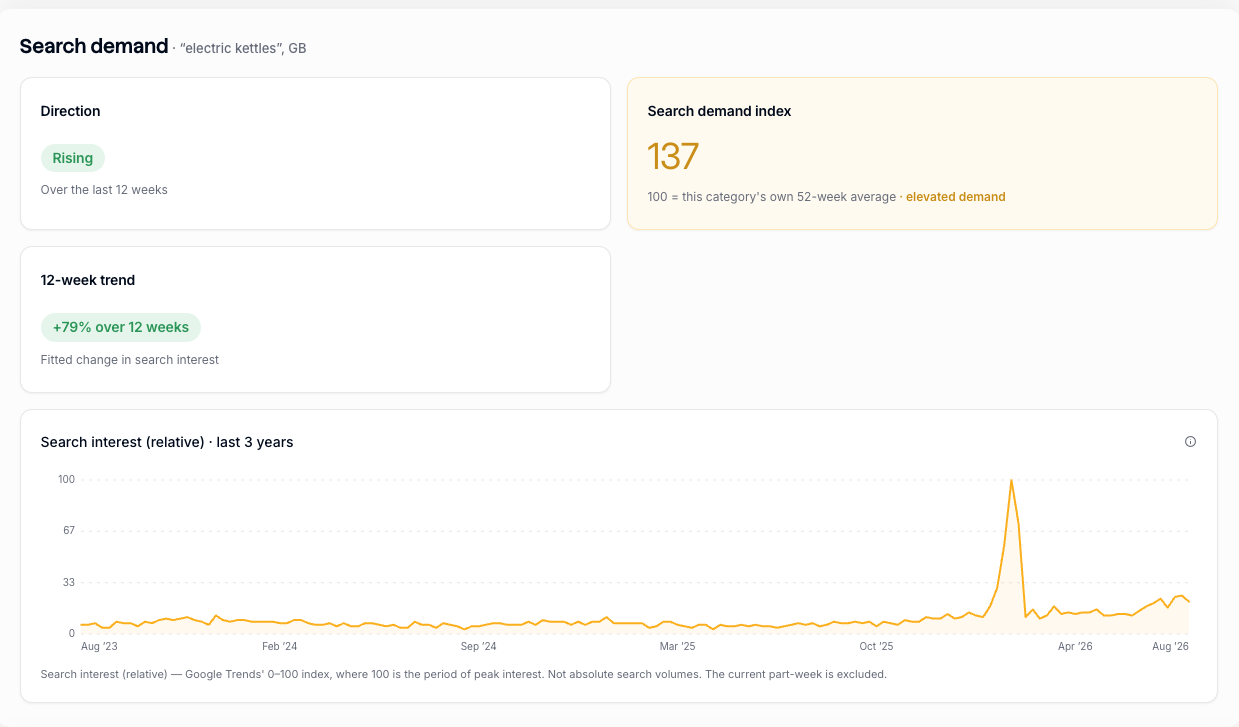
Share of brand search
A table of tracked brands showing each brand's share of category brand search over the last four weeks, its 12-week trajectory, its current shelf rank, and a verdict.
Brands below the measurement floor are shown as Not measurable rather than as zero, with no share, slope or ranking figure invented for them. On concentrated categories this is common and is itself the finding: if only two of a dozen tracked brands register measurable brand search, the category is concentrated at the search level and a new entrant is building brand demand from nothing against entrenched names.
The most useful column is the combination of share and shelf rank. A brand with high shelf rank and no measurable brand search is winning on shelf mechanics, not brand pull. A brand with high brand search and a declining share trajectory may be normalising seasonally rather than retreating structurally — the table flags the ambiguity rather than resolving it for you.
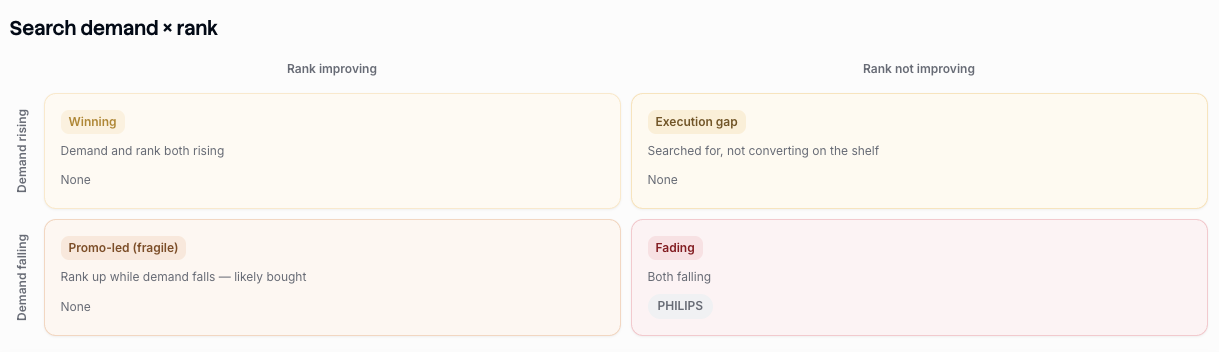
Search demand x rank
This quadrant plots demand trajectory against rank improvements to tell you where the two correlate in regard to brand success.
Rising search needs
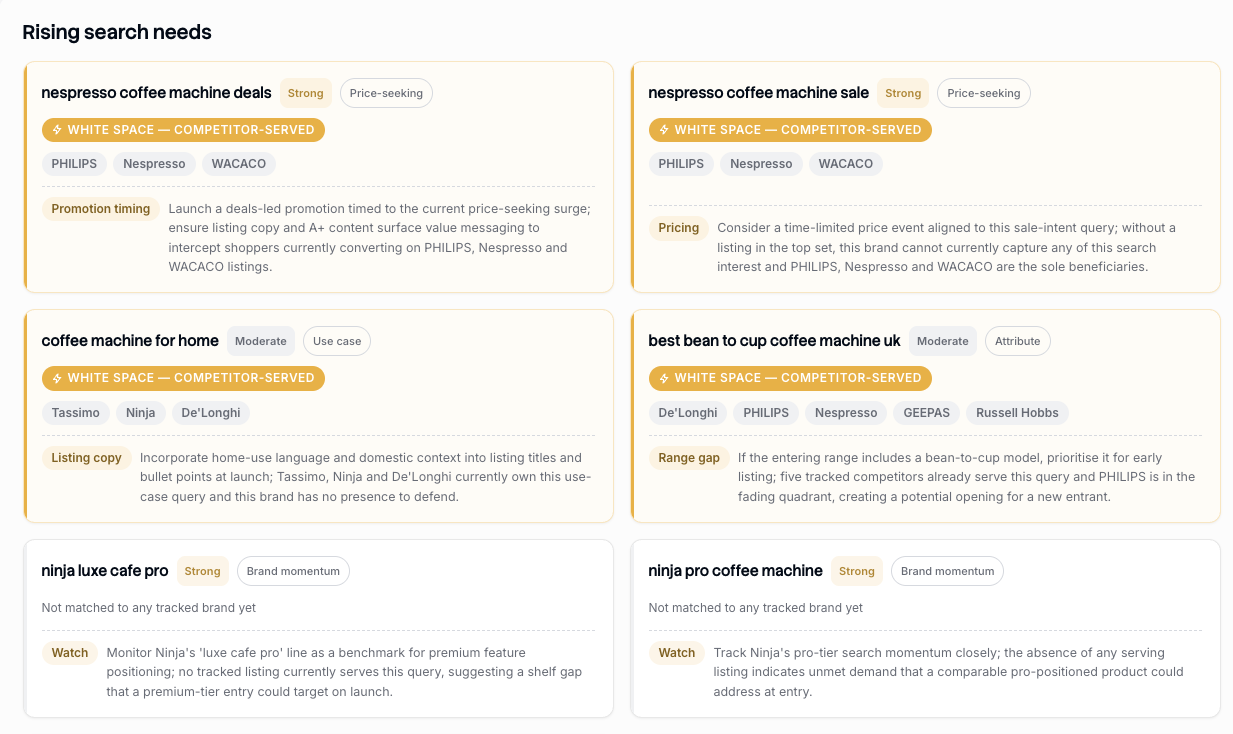
The most actionable section. Each rising term is presented with:
> * Growth strength — moderate, strong or breakout.
> * Type — attribute, use case, adjacency or brand momentum. This tells you what kind of response is appropriate.
> * Whether it is white space, and which tracked brands already serve it — or a note that no tracked brand has been matched to it yet.
> * A recommended action, tagged by the function that owns it: listing copy, content, range gap, or watch.
Those tags matter. An attribute term that matches your product and is rising is a listing-copy job you can do this week. A use case term signals buying-guide intent, which is a content job. An adjacency that is breaking out with almost nobody serving it is a range question for product, not a marketing one. And a brand momentum term is usually a watch item — a competitor benchmark that tells you what expectations you would need to beat.
A term with no tracked brand matched to it is worth particular attention: it means consumers are pulling toward something that nobody on your tracked shelf currently answers.
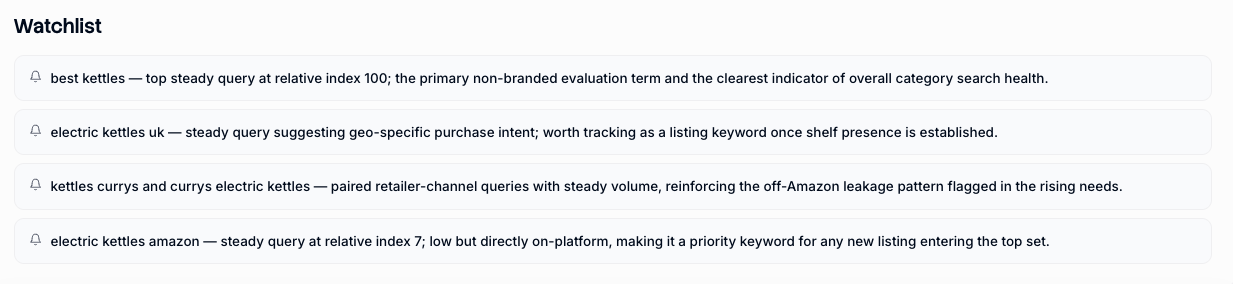
Watchlist
Four or five sentences pulling the page's implications together — the demand headwind or tailwind, the competitor whose trajectory most threatens you, any structural problem with your own listing, and the concentration picture. This is the section to paste into a weekly update.