
Features: specification comparison and your openings
The Features page (Feature Comparison) lays every tracked product's specification side by side in one table, then reads it for you: which attributes are table stakes, which ones separate the leaders, and which ones nobody is claiming. All of the information is exportable.
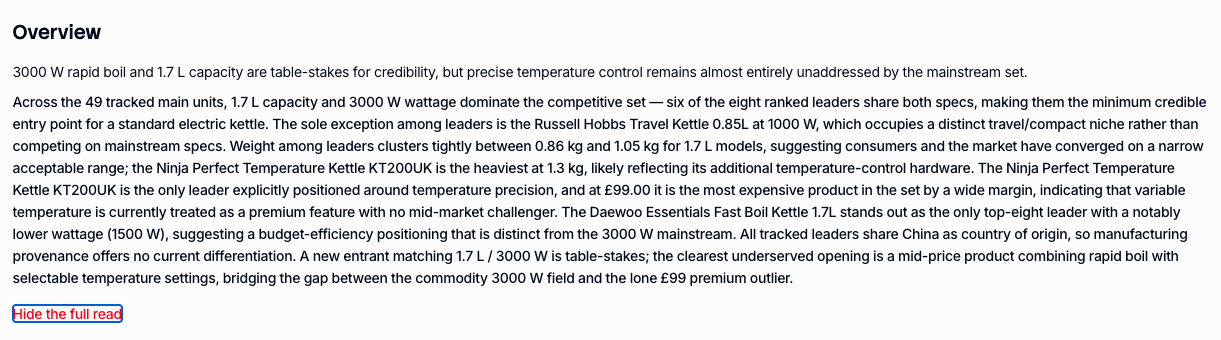
The written read
The page opens with a paragraph summarising the specification landscape: what dominant formats or technologies the category is built around, where your product sits against the leader, which specifications recur often enough to be table stakes, where the spread is wide enough that an attribute is a live differentiator, and which fields are thinly populated across the set.
Thin fields are worth reading closely. If almost no competitor states a value for an attribute, and yours does, that is an underexploited angle — not because the competitors lack the feature, but because they are not selling it.
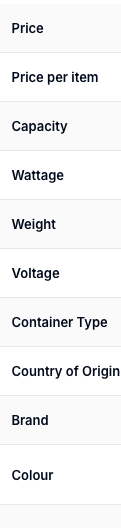
Side by side: the main-unit set
The comparison table itself, showing the main units on the shelf (accessories and spare parts are separated out, so you are comparing like with like). Products run across the top in rank order with brand, name and rank; attributes run down the side.

Typical rows include price and price per item, weight, colour, dimensions and size, number of items and unit count, installation type, power source and fuel type, control type, heating method, material and finish, warranty, included components, special features, model and manufacturer part number.
Controls let you Compare a selected subset, see how many of the set are shown, and open Full screen for a wide table. Missing values are shown as an em dash — meaning the listing does not state it, not that the product lacks it.
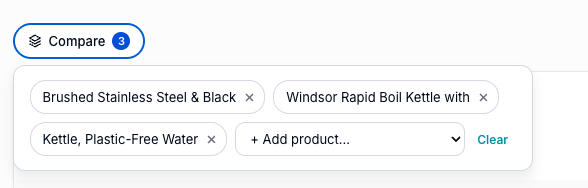
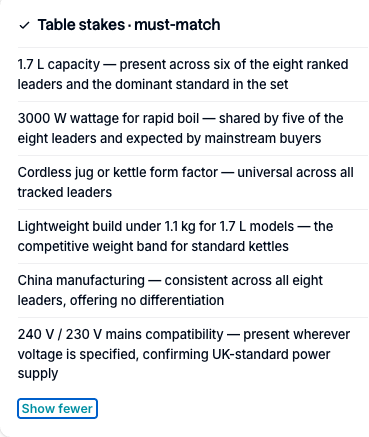
Table stakes · must-match
Attributes present across the majority of ranked units, each with named examples. These are your baseline. If your product misses one, either fix the product or be very deliberate about how you explain the difference — an absent table-stakes attribute on a shelf where everyone else has it reads as a gap to a shopper comparing listings.
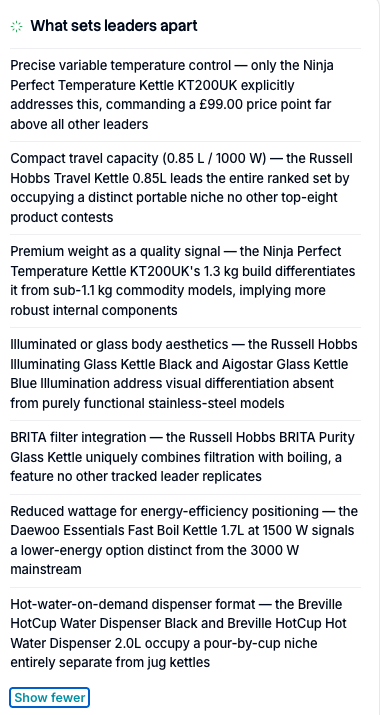
What sets leaders apart
Attributes that are rare across the set but concentrated among high-ranking products. These are the specification stories the winners are telling. A rare attribute at the top of the shelf is not proof it causes the ranking, but it does tell you what claims are currently
working in this category.
Your openings
Attributes your product has that no tracked competitor lists in their feature values. These are the claims you can make without immediate contradiction — and, framed properly, they are the basis of your listing's differentiation section.
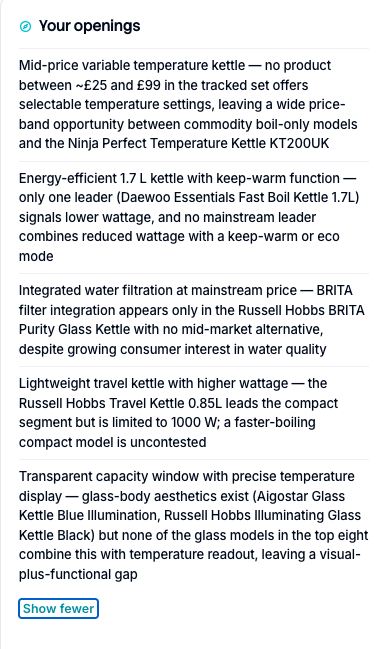
The caveat matters. "Absent from every competitor's listed feature values" means absent from what they have chosen to publish in their structured attributes. A competitor may well have the feature and simply not list it. Before building a headline claim on an opening, do the ten-minute check: read two or three competitor listings properly, including images and A+ content. What the page reliably tells you is that nobody is selling on that attribute, which is often more useful than whether they technically have it.
Watch-outs
Attribute data comes from retailer listings, so it is only as complete and as accurate as the sellers made it. Field names vary between sellers and can appear near-duplicated. Units are inconsistent across listings — capacity in particular can be stated in litres, cubic inches or kilograms on the same shelf — so read those rows with care rather than sorting on them. And an em dash always means "not stated", never "not present".
Finally: matching a specification is not the same as winning on it. Combine this page with Reviews, where you can see which specifications customers actually talk about, and Search, where you can see which attribute language they are typing.