
Share of Wallet: the jobs your category is hired for
Share of Wallet is the widest lens in the tracker. It starts from the jobs customers hire your category to do, then maps out everything else competing to do those jobs — other product categories, and the services and experiences competing for the same money.
Your competition is not just your category
Every page before this one assumes the shopper has already decided to buy a product like yours, and asks who they buy it from. Share of Wallet questions that assumption.
Customers do not buy categories; they hire something to get a job done. Once you frame it that way, the competitive set widens sharply. A customer who wants to entertain friends outdoors might buy your product — or a barbecue, or a fire pit, or simply order takeaway three times. Those are all bids for the same money and the same occasion, and none of them appear on a category best-seller shelf.
This matters commercially in three ways. It explains demand shifts your category data cannot: if your category is flat but a substitute category is growing quickly, you are losing the job, not the shelf. It identifies adjacent categories worth entering. And it tells you what your marketing is actually arguing against — often a service, not a product.
The jobs this category gets hired for
The page opens with the jobs themselves, each written as the customer would describe it, and each with a list of what it competes with.
Read these as separate markets rather than as one. A brand competing for a functional job ("get this specific outcome at home") is fighting on performance and price. A brand competing for an experiential job ("host and entertain") is fighting on theatre, sociability and how the product looks in someone's home. And a brand competing for a lifestyle job is fighting on aspiration, where the substitutes are barely products at all.
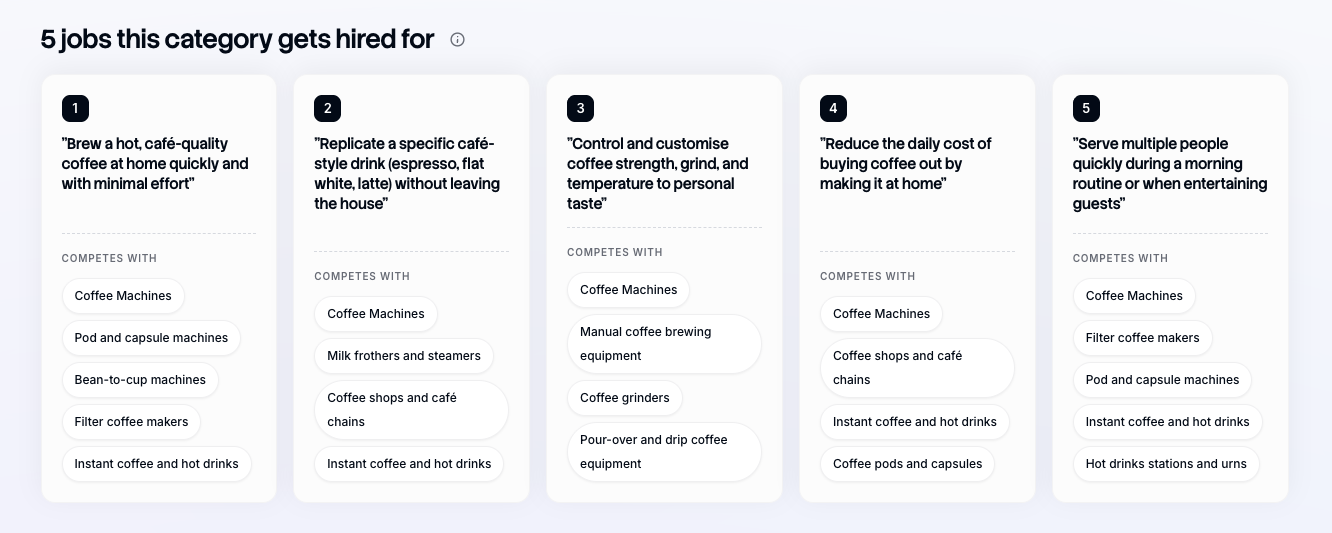
Most products can be honestly positioned against more than one job. Which one you choose determines your price ceiling, your imagery, your channel and who you benchmark against — so this list is a positioning decision, not a description.
Direct → Indirect → Share of wallet
Below the jobs, the same competitive landscape is laid out in three widening tiers.
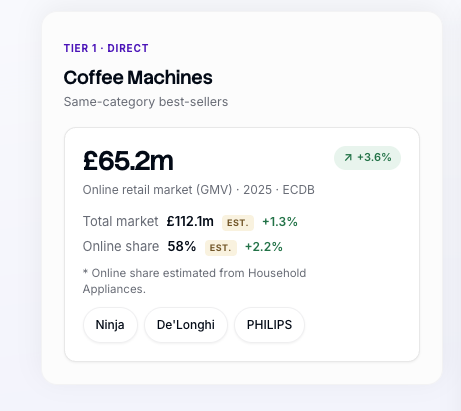
Tier 1 · Direct
Your own category — the tracked best-sellers, the set every other page covers. Shown with online retail market value, an estimated total market, the online share of that market, and the growth trend.
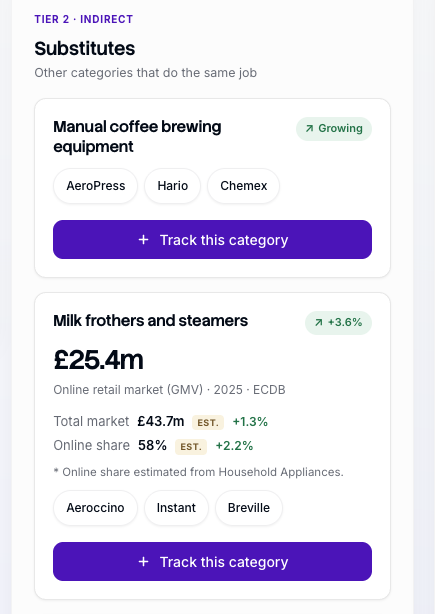
Tier 2 · Indirect
Substitute categories: different products that do the same job. Each is shown as a card with its growth direction, online retail market value, total market and online share, plus the leading brands in that category.
The comparison to make here is growth, not size. A substitute category growing faster than yours is absorbing demand for the job you both serve. A substitute several times your category's size is not necessarily a threat — it may simply be a bigger market you were never in — but a fast-growing one is a signal worth acting on.
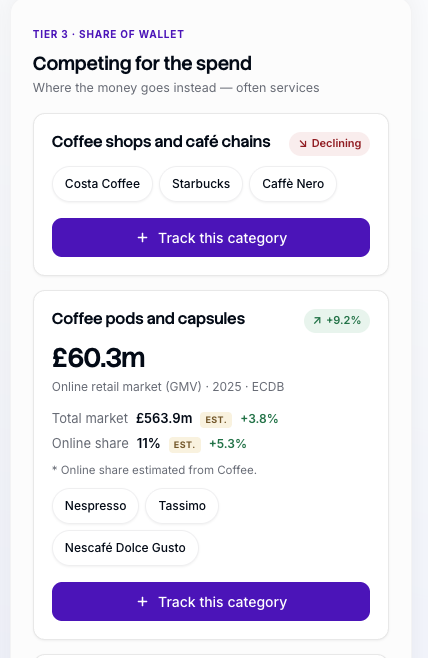
Tier 3 · Share of wallet
Where the money goes instead — often services rather than products. Food delivery, experiences, and other discretionary spending that competes for the same budget and the same occasion.
This tier rarely produces a direct competitive response, but it is the sharpest input to messaging. When your real competition is "order in instead", your argument is about cost-per-use, repeat value and the experience of doing it yourself — not about your specification against a rival's.
Track this category
Each substitute and share-of-wallet card carries a Track this category action, which starts a full tracker on that category. This is the intended workflow: use Share of Wallet to identify where you should be looking, then track it properly.

Watch-outs
Market sizes here are estimates with stated derivation, not measured sales. Online share figures are frequently inherited from a parent category. And a substitute category being large is not by itself a threat — growth direction and overlap with your specific job matter far more than absolute size.